 Visit Mexico City Guide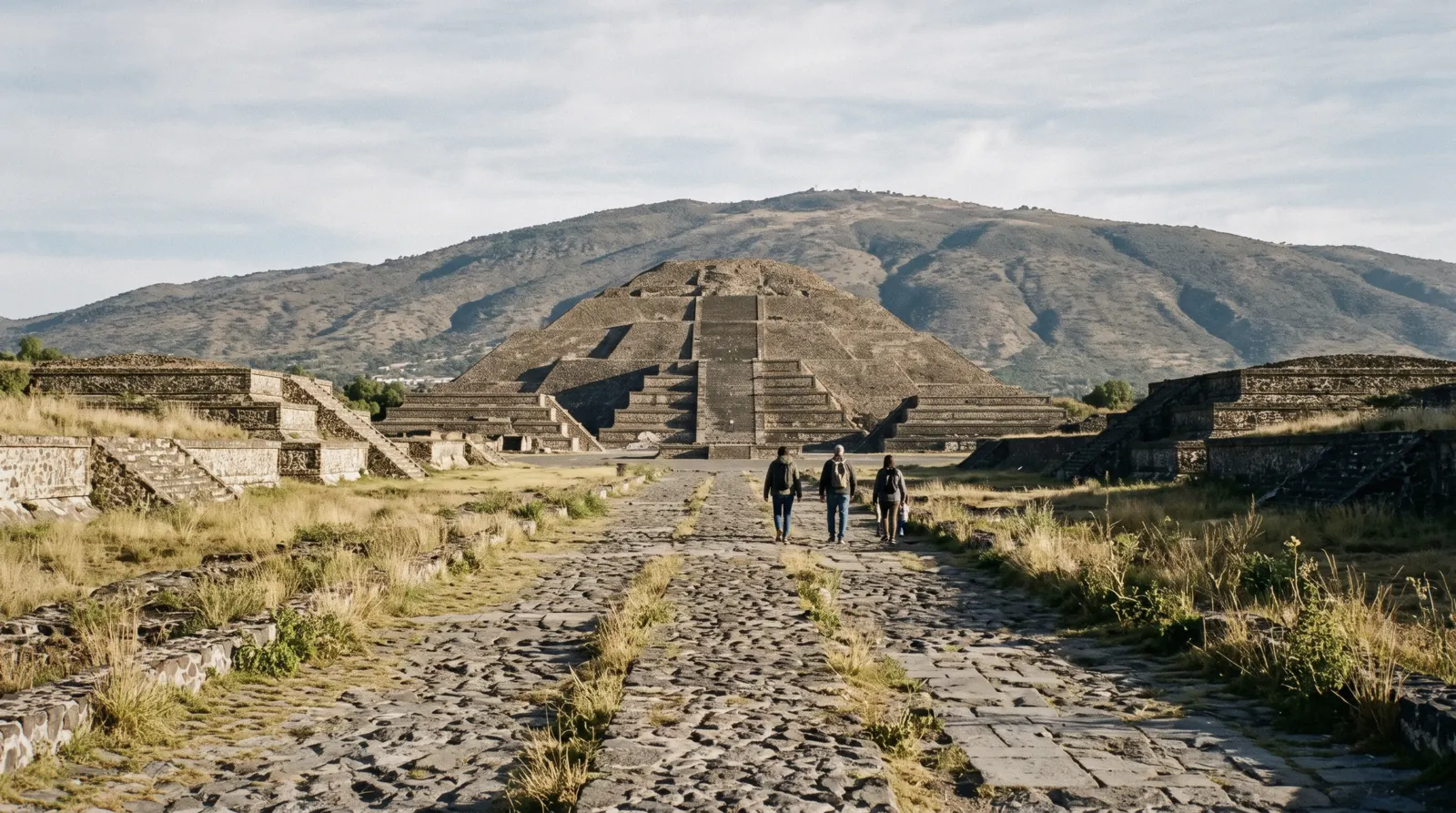
Teotihuacán: The Pyramids An Hour From Mexico City (2026)
Teotihuacán is the largest ancient city in the Americas that anyone can walk into on a Tuesday morning: two enormous pyramids at either end of a two-kilometre avenue, an hour north-east of Mexico City. It was already a ruin when the Mexica found it and gave it the name we still use, and nobody knows what its own people called it or what language they spoke. The zone opens every day, 08:00 to 17:00, with the last entry at 16:30 — hours, prices and the climbing rules below were read on INAH's own pages on 30 August 2026.
Quick answer Hours, price, what you can climb, and how to get there
Teotihuacán opens every day of the year from 08:00 to 17:00, with the last entry at 16:30. A non-resident foreign visitor pays MX$210, about US$12.35; Mexican nationals and foreign residents pay MX$105. Nothing is timed, so no ticket needs to be held in advance.
Key takeaways
- Climbing the Pyramid of the Sun has been prohibited since 2020 and INAH repeated it in its spring 2026 bulletin; the Pyramid of the Moon's first platform is open again as of 23 April 2026 — the full picture is below
- It is one of the few major sights open on a Monday, when the city museums close, which is where it belongs in a four-day trip
- Without a tour, the coach from Terminal Central del Norte runs every 15 to 20 minutes from 06:00 and takes about an hour to Puerta 1; with one, an early-access departure is on the Avenue before the coach parties
- Allow three to four hours on the site: the Avenue of the Dead is two kilometres long, it sits at about 2,300 m, and there is almost no shade on it
- Where the pyramids fit a four-day trip is covered in our Mexico City guided tours
Key facts
Opening hours
| Daily, all year | 08:00–17:00 |
|---|---|
| Last entry | 08:00–16:30 |
Closed None stated by INAH
Admission
- Adult
- MX$210 (about US$12.35) for non-resident foreign visitors
- Reduced
- MX$105 for Mexican nationals and foreign residents with proof
- Free
- Under 13, disabled visitors, students and teachers with credential, INAPAM over-60s; Sundays for nationals and residents
Planning it
- Time needed
- Not stated by INAH; our routing: 3 to 4 hours on the site plus 2 hours of travel
- Book ahead
- Optional — walk-up usually fine
- Address
- Zona Arqueológica de Teotihuacán, San Juan Teotihuacán, State of Mexico
What It Costs To Get In
INAH's own gate price against the platform listings, all read on 30 August 2026 and converted at US$1 = MX$17.0. The first row is the official ticket and its link carries no tracking of ours; the rest are worth their money for the transport, not the entry.
One question decides the row: are you paying for entry, or for the transport and a guide? The gate sells entry for MX$210; everything below it is transport and company.
| Option | Price | Includes | Cancel | Book |
|---|---|---|---|---|
| INAH ticket, at the gate or onlineThe right ticket for anyone taking the bus or a car; nothing else is cheaper | MX$210 foreign / MX$105 resident | The whole zone and the site museums | Not stated by INAH | Official site |
| Platform entry ticketOnly if you want a booking in hand; there is rarely a queue to skip | Listed at $29 | Entry only, straight through the turnstiles | Free up to 24 hours before | Check Availability |
| Early-access tour with transportThe right choice for a first visit without a car: on the avenue before the coaches | Listed at $68 | Entry, coach from the city, licensed guide, small group | Free up to 24 hours before | Check Availability |
| Teotihuacán and the Basílica de Guadalupe, with lunchFor a single full day that also covers the Basílica and lunch | Listed at $68 | Both sites, transport, lunch, guide | Free up to 24 hours before | Check Availability |
At the gate the entry is MX$210, and INAH's own online shop is ventadeboletosenlinea.inah.gob.mx — no other site is an official seller. A platform entry-only ticket at $29 is roughly double the gate price, and there is rarely a queue to skip; the arithmetic is set out on the tickets page.
Ways To Reach The Pyramids
Each card links to the operator's own page, where the calendar shows the dates still open. Prices in US dollars as listed on 30 August 2026.
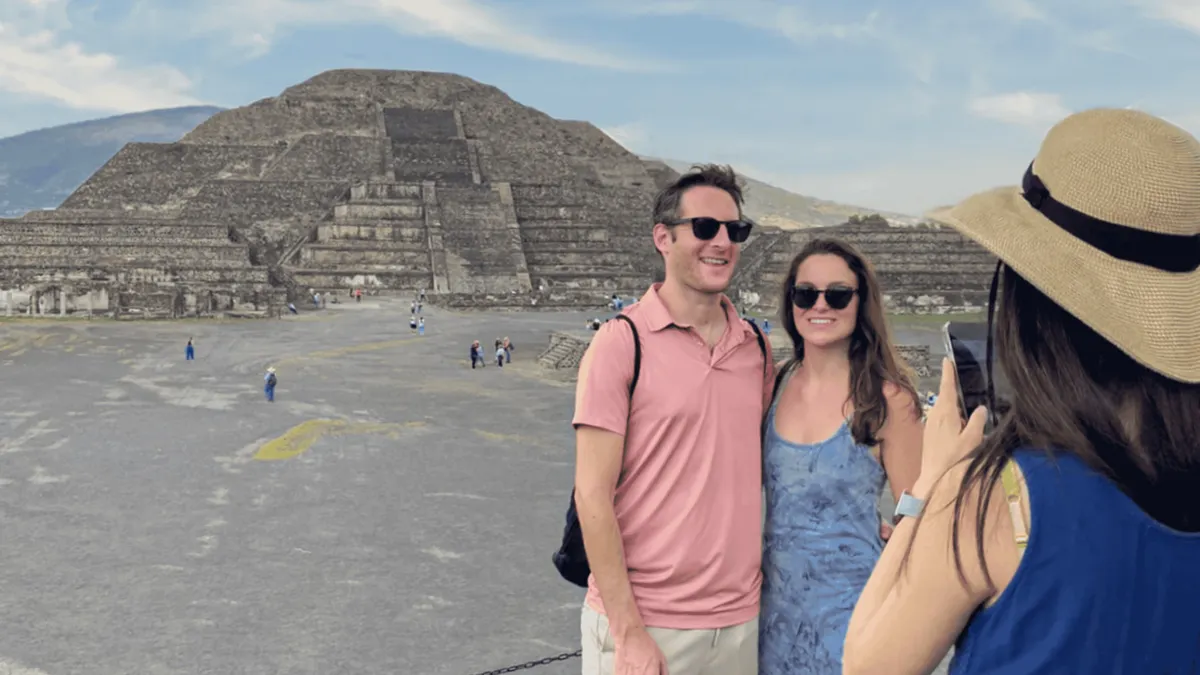 from $68
Mexico City: Teotihuacan Early Access Tour & Optional Lunch
Early access at the gate before the coaches arrive, with transport from the centre and a licensed guide.
Check Availability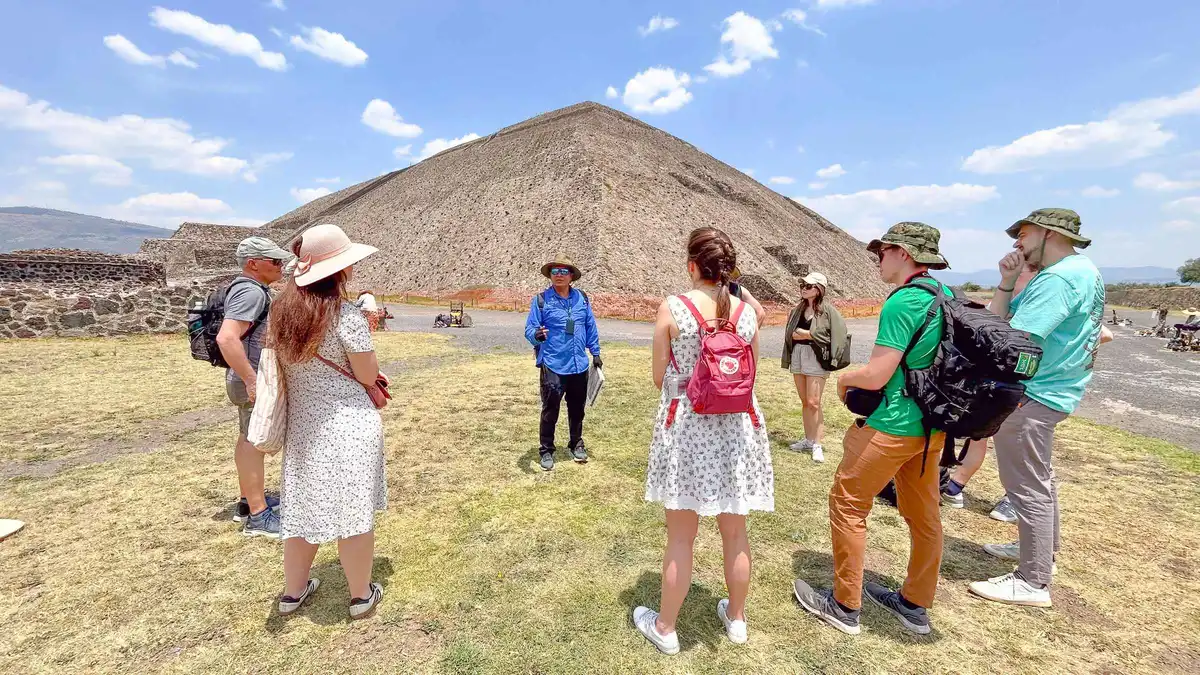 from $68
Mexico City: Teotihuacan & Guadalupe Shrine Tour with Lunch
Full day to the pyramids with the Basílica de Guadalupe and lunch — the version most first visits take.
Check Availability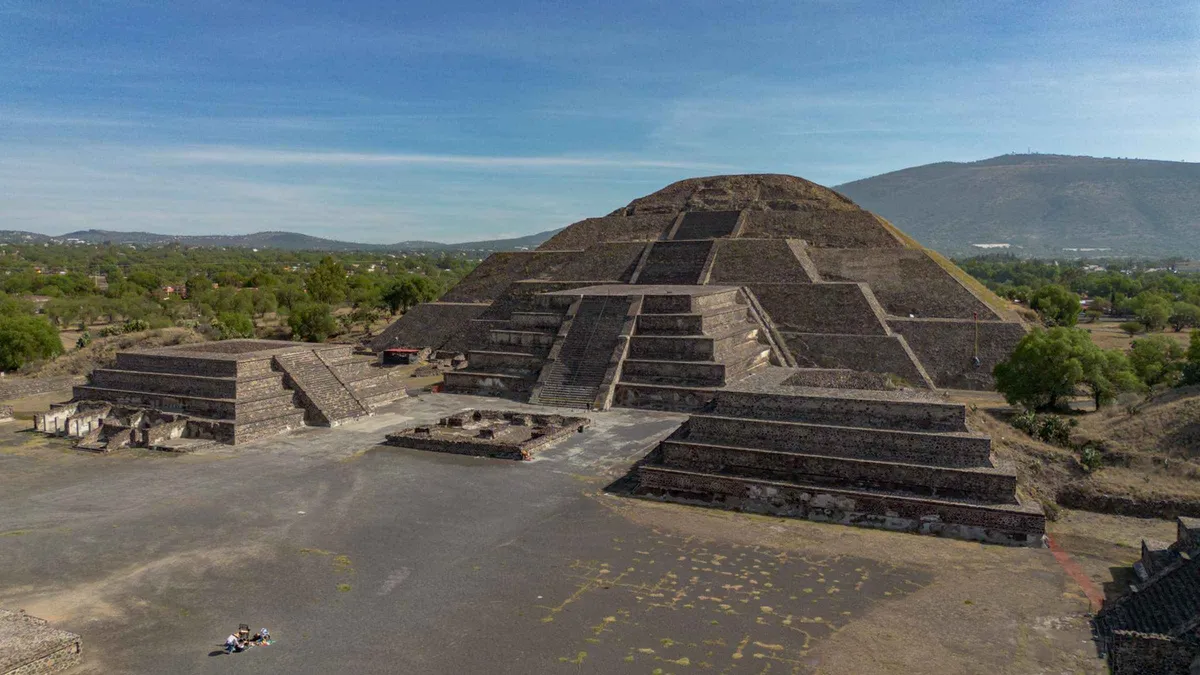 from $29
Teotihuacan Pyramids: Skip-the-Line Ticket
Entry ticket only, delivered to your phone; the gate price is MX$210, so read the comparison before you buy.
Check Availability from $162
CDMX: Teotihuacan Balloon Flight with Optional Pyramids Tour
Balloon flight over the pyramids at sunrise, with the option to add the guided site visit afterwards.
Check AvailabilityPrices, ratings and details are the platform's own. Dollar figures are the listed prices. The platform bills in your account's currency.
What You Can And Cannot Climb In 2026
The most-asked question about this site, and the answer has changed three times since 2020. Dates and wording below come from INAH's own bulletins.
The Pyramid of the Sun is closed to climbers. Access to the summit was suspended in 2020 as a pandemic measure and has never been restored. INAH's spring 2026 bulletin states it again — no se permitirá el ascenso a la Pirámide del Sol — and asks visitors to keep to the Sun and Moon plazas. No reopening date has been published.
The Pyramid of the Moon: the first platform only
After five years closed, INAH reopened the Pyramid of the Moon to visitors on 19 May 2025, and only as far as the first body of the structure — the wide platform at the foot of the upper stairway, not the summit. On 20 April 2026 an armed man opened fire at the pyramid, killing a Canadian visitor and injuring thirteen people; access was suspended, and the first platform was reopened on 23 April 2026. That is the position as last published.
It is the most volatile fact on this site, so treat it as a plan rather than a promise and confirm at the gate on the day.
What is always allowed
Walking the whole Avenue of the Dead, entering the Ciudadela and standing in front of the Temple of the Feathered Serpent, climbing the smaller platforms that line the avenue, and going into the Quetzalpapálotl palace complex with its painted patio. Drones are prohibited, as is any activity on the basements themselves — INAH lists both in the same bulletin.
Who Built It, And Why It Is Neither Maya Nor Aztec
Three of the four questions Google shows for this site are about who made it. Here is the short, honest version.
Teotihuacán was built by people whose name we do not know, in a language nobody has identified, from about the first century CE. At its height, somewhere around 400 CE, it held perhaps 100,000 to 200,000 people, which made it one of the largest cities on earth at the time and by far the largest in the Americas. Its centre burned in the sixth century and the city was substantially abandoned by around 550 CE.
Not Maya
Teotihuacán is not a Mayan city. The Maya cities were contemporaries, not builders here: Tikal and Copán lie 1,000 km and more to the south-east, and their relationship with Teotihuacán was one of trade, influence and — on the evidence of a famous inscription at Tikal — at least one violent intervention. The architecture is different, the Mayan writing system has no counterpart here, and the pyramids carry the talud-tablero profile that is Teotihuacán's own signature.
Not Aztec either — the Mexica were the tourists
The Aztecs and Teotihuacan are not the same people and not the same era. The Mexica, the people usually called Aztec, arrived in the Valley of Mexico some 700 years after this city fell, found the ruins, decided the place was where the gods had created the present world, and gave it the Nahuatl name that stuck. Teotihuacán, the Pyramid of the Sun, the Pyramid of the Moon and the Avenue of the Dead are all Mexica names for things whose original names are lost.
The Aztec capital, Tenochtitlan, was 50 km south under what is now the Zócalo — a different city, a different millennium.
Teotihuacán In Eight Dates
The dates archaeologists broadly agree on, from the first settlement to the rules that apply to a visit this year. Dates before the Spanish period are approximate to within a generation or two.
-
c. 100 BCE
First settlement in the valley
Villages grow along the river at the valley floor; the city's grid is laid out over the following two centuries.
-
c. 100–250 CE
The Pyramid of the Sun, then the Moon
The Sun is raised first, over a cave, and the Moon completed at the northern end of the Avenue of the Dead.
-
c. 200 CE
The Temple of the Feathered Serpent
The most sculptural building on the site is finished, with more than 200 sacrificial burials beneath it.
-
c. 400–450 CE
The peak
Perhaps 100,000 to 200,000 people, one of the largest cities on earth and by far the largest in the Americas.
-
c. 550 CE
The centre burns
The ceremonial core is deliberately burned and the city is substantially abandoned within a generation.
-
1300s–1400s
The Aztecs name it
Centuries after the fall, the Mexica call the ruins Teotihuacán, 'the place where the gods were made', and treat it as a pilgrimage site. The builders' own name for it is unknown.
-
1905–1910
Batres excavates the Sun
Leopoldo Batres clears and reconstructs the Pyramid of the Sun for the 1910 centenary of Mexican independence; the profile you see is partly his.
-
1987, then 2020
World Heritage, then the climbing ban
UNESCO inscribes the site in 1987. Summit access to the Pyramid of the Sun is suspended in 2020 and, as of INAH's spring 2026 bulletin, has not been restored.
Sources: the UNESCO World Heritage listing for the Pre-Hispanic City of Teotihuacan (whc.unesco.org/en/list/414), INAH's site page, and the archaeological chronology summarised on Wikipedia's Teotihuacan article; INAH's 2026 bulletin for the climbing rule.
What To See, In Walking Order
Entering at Puerta 1 and walking north, which is how the coaches and the buses arrive and how the city was meant to be read.
The Ciudadela and the Temple of the Feathered Serpent. A sunken square the size of several football pitches, with the city's most sculptural building at its far side: rows of stone serpent heads and Tlaloc-like faces, the only heavily carved facade on the site. Beneath it archaeologists found more than 200 sacrificial burials, and in 2003 a tunnel running under the temple filled with mercury and mica. Fifteen minutes, more if the sun is low and the shadows are working.
The Avenue of the Dead
Two kilometres of straight processional road, laid out 15.5 degrees east of north, lined with platforms that were temples and apartment compounds. It rises gently as you go north, so the walk to the Pyramid of the Moon is uphill and the walk back is not. There is no shade at all on this stretch.
The Pyramid of the Sun
Sixty-five metres tall on a base almost as wide as Giza's Great Pyramid, built over a cave that may be the reason the whole city sits where it does. You cannot climb it; the view of it from the avenue, or from the platform of the Moon, is what you came for.
The Plaza of the Moon and the Quetzalpapálotl palace
The northern end, and the best composition on the site: the smaller pyramid framed by twelve platforms, with the Cerro Gordo behind it. To the west, the Quetzalpapálotl palace complex has carved pillars, red-painted walls and the Jaguar murals — the only place where you get a sense of what the colour of this city was like.
The two museums
Both are covered by the same ticket and both are usually empty. The Museo de Sitio near the Pyramid of the Sun holds the scale model everyone photographs; the mural museum holds the fragments of painted plaster that once covered nearly every surface here. Twenty minutes each, and they are the shadiest rooms on the site at two in the afternoon.
How Much Time To Give Teotihuacán
INAH publishes no visit length, so these are our three routings against the gate hours: open 08:00, last entry 16:30, close 17:00. The travel time is the same whichever you pick.
The site is two kilometres long and every route walks it at least once, so the shortest honest visit is two hours. The difference between the routings is the museums and the northern end.
| Routing | On the site | Door to door from the Centro | What you skip |
|---|---|---|---|
| The Avenue and both plazas | 2 h | About 5 h by bus | The two museums and the Quetzalpapálotl palace |
| The full walk, museums included | 3–4 h | 6–7 h by bus | Nothing; this is the page's own routing |
| A coach tour with the Basílica and lunch | 3 h at the site | 8–9 h, hotel to hotel | Your own pace, and the empty 08:00 hour unless it is an early-access departure |
Whichever routing you take, the museums are the shadiest rooms on the site at two in the afternoon and are usually empty. Save them for the hottest hour rather than the first one.
Getting There Without A Tour
The coach is the cheapest way and the least trouble; the honest caveat is the last hour of the day, which is where independent visits go wrong.
Autobuses Teotihuacán run from Terminal Central del Norte — metro Autobuses del Norte, Line 5 — from about 06:00, every 15 to 20 minutes, and take roughly an hour to the site, stopping at the town of San Juan Teotihuacán and then at Puerta 1 and Puerta 2. Fares are reported at MX$52 to MX$60 one way; the operator publishes no fare table we could read, so buy at the counter and expect the price to be in that band. Ask for las pirámides, not San Juan, or you will be set down in the town.
| How you go | Cost, one person | Door to door | Gets you there by | Trade-off |
|---|---|---|---|---|
| Coach from Terminal Norte + gate ticket | About MX$320 return with entry | 2 h 15 each way including the metro | 09:30 if you leave at 07:00 | Cheapest; no guide, no lunch, and the return is on you |
| Guided tour with transport | From $68 | Hotel pickup on many options | 08:00 on the early-access departures | Costs about four times more; buys the early gate and the explanation |
| Tour with the Basílica and lunch | From $68 | Nine hours | Two sites in a day | A long day; the Basílica is 30 minutes of it |
| Balloon at dawn, then the site | From $162 | Pre-dawn start | Sunrise over the avenue | Weather-dependent and the most expensive way to see it |
| Driving | Tolls plus parking, about MX$200 | 1 h 15 | Whenever you like | Parking fills by 11:00 in high season |
Which gate
There are five. Puerta 1 sits at the southern end by the Ciudadela and is where the buses stop — start here and the site unfolds in the order it was built to be walked. Puerta 2 is nearest the Pyramid of the Sun and useful if you are short of time.
Puerta 3 serves the Plaza of the Moon at the northern end, which is the one to leave from if you have walked the avenue and do not want to walk it back.
When To Go, And What The Site Does To You
Altitude, sun and rain, in that order of how much they matter.
The site is at about 2,300 m, a hundred metres higher than the city, and the Avenue of the Dead is a two-kilometre walk with no shade. That combination is what makes people describe Teotihuacán as harder than they expected. Bring more water than you think, a hat, and sunscreen — the altitude thins the protection the air gives you.
The gates open at 08:00 and the coach parties arrive from about 10:00. The first two hours are the cool ones and the empty ones. From June to September the rain arrives in the afternoon, usually after four, by which time you should be heading for the exit anyway given the 16:30 last entry and 17:00 close.
The days to avoid, and the one people plan for
The spring equinox, around 21 March, brings tens of thousands of people in white to the site; INAH runs a special operation, the plazas fill and the pyramids are still closed to climbing. Sundays are busy because entry is free for Mexican nationals and residents. Monday, closed everywhere else in the city, is quietly one of the better days here.
Dos And Don'ts At Teotihuacán
The short version of everything above, for the morning you go.
Do
- Be at a gate at 08:00; the coach parties arrive from about 10:00 and the first two hours are the cool, empty ones
- Go on a Monday, when the city's museums are shut and this site is not — what closes
- Start at Puerta 1 by the Ciudadela and walk north, so the site unfolds in the order it was built to be walked
- Carry more water than seems sensible, a hat and sunscreen: two kilometres with no shade at 2,300 m
- Take the two museums at the hottest hour; they are covered by the ticket and usually empty
Don't
- Don't plan to climb the Pyramid of the Sun; it has been closed since 2020, and the Moon opens only to its first platform — the current rule
- Don't make it your first day in Mexico; the site sits a hundred metres above the city and the altitude is felt on the avenue
- Don't go on a Sunday or around the spring equinox: free entry for nationals and residents, and tens of thousands in white on 21 March
- Don't pay a platform US$29 for entry alone expecting a queue to skip; the gate charges MX$210 and rarely has a line — the arithmetic
- Don't fly a drone or step onto the basements; INAH prohibits both in the same bulletin
Teotihuacán Map: Gates, Pyramids And Museums
The five gates, the two pyramids, the Ciudadela and the two museums, so you can decide where to start and where to leave from.
Five Things Most Visitors Do Not Know About Teotihuacán
Facts that change how the site reads, each with where it comes from.
- Nobody knows what its builders called it. Teotihuacán is Nahuatl, the Aztecs' name, given centuries after the city fell; the language of the people who built it has not been identified. (UNESCO listing; Wikipedia, Teotihuacan) - The whole city is turned 15.5 degrees east of north. The Avenue of the Dead and every building on the grid share the alignment, which is why the Pyramid of the Sun faces the point where the sun sets on two specific days a year. (Wikipedia, Teotihuacan) - There is a river of mercury under the Feathered Serpent. A tunnel found beneath the temple in 2003 held pools of liquid mercury, mica-lined walls and pyrite spheres, reported by the INAH team in 2015.
(INAH; Reuters, April 2015) - The Pyramid of the Sun has almost the footprint of Giza's Great Pyramid — about 220 metres a side against Giza's 230 — at less than half the height, 65 metres against 146. (Wikipedia, Pyramid of the Sun) - Most of what you see was painted. Nearly every plastered surface carried murals in red, green and ochre; the fragments in the mural museum and the Quetzalpapálotl patio are what survived four hundred years of weather after the abandonment. (INAH site museum)
Eating At The Site
There is food at the gates and one restaurant of note; nothing inside the zone itself.
Stalls outside Puerta 1 and Puerta 2 sell water, fruit and quesadillas at roadside prices, and the town of San Juan Teotihuacán has fondas around its square. The restaurant the coach tours use is La Gruta, in a natural cave a few minutes' walk east of Puerta 5, which its own site dates to 1906 (lagruta.mx); it is a set-menu, tour-bus lunch and priced as one, but the cave is genuinely worth seeing and the table is cool at two in the afternoon. Carry your own water either way: the vendors on the avenue are intermittent and the distances are real.
Next Stop From Teotihuacán
Walk minutes are our estimates; the rest are driving times on a weekday.
Basílica de Guadalupe
Free, open 06:00 to 21:00 daily, and the stop most Teotihuacán day tours already include — including this one.
40 min by road, on the way backSan Juan Teotihuacán
The town beside the site, where the buses stop and where the cave restaurants and obsidian workshops are.
10 min by roadMexico City
Back to what to do in Mexico City — the pyramids are the one day out that fits inside a four-day first visit.
1 h by coachTeotihuacán Questions
Can you still climb the pyramids at Teotihuacán?
Not the Pyramid of the Sun: climbing it has been prohibited since 2020, and INAH repeated the prohibition in its spring 2026 bulletin. The Pyramid of the Moon's first platform — not its summit — reopened on 19 May 2025 and, after being suspended following the attack of 20 April 2026, was reopened on 23 April 2026. The full sequence is above, and this is the one fact on this page to confirm at the gate.
Is Teotihuacan a Mayan city?
No — Teotihuacan is not a Mayan city, and the Aztecs and Teotihuacan are not the same either. It was built from about the first century CE by people whose language and name are unknown, peaked around 400 CE with perhaps 100,000 to 200,000 residents, and was largely abandoned by 550 CE, centuries before the Mexica arrived and named it. The longer answer is above.
How much does Teotihuacán cost to enter?
MX$210 for a non-resident foreign visitor and MX$105 for Mexican nationals and foreign residents with proof, since INAH's tariff changed on 1 January 2026. Under-13s, disabled visitors, students and teachers with a credential enter free, and Sunday is free for nationals and residents only. The tickets page compares that with the platform listings.
How long do you need at Teotihuacán?
INAH publishes no suggested length. Our routing is three to four hours on the site — the Avenue of the Dead alone is two kilometres each way — plus about two hours of travel from central Mexico City. A tour that promises the pyramids plus two other stops in one day is giving you rather less than that.
Is Teotihuacán open on Mondays?
Yes. It opens every day of the year, 08:00 to 17:00, with the last entry at 16:30, which makes it the obvious Monday when the Anthropology Museum, Chapultepec Castle and the Casa Azul are all closed.
Can you visit Teotihuacán without a tour?
Easily. The coach from Terminal Central del Norte leaves every 15 to 20 minutes from around 06:00, takes about an hour, and sets down at Puerta 1; fares are reported between MX$52 and MX$60 each way. With the MX$210 entry that is roughly MX$320 for the day against about US$68 for a guided departure — the comparison is above.
Where This Fits In A Day
One rule decides it: this is the Monday.
Give Teotihuacán the day the city's museums are shut and nothing else in your plan moves. Leave by 07:00, be on the Avenue by 09:30, walk north, take the museums when the sun is highest, and be back in the city by mid-afternoon — which still leaves the Basílica de Guadalupe if you are travelling by road and it is on the way.
If you are on the four-day plan, this is the day that turns a city break into a trip. Do not schedule it for a Sunday: the free-entry day for nationals and residents makes it the busiest of the week, and you would be paying full price for the crowd.
Teotihuacán On Film: The Avenue, The Climb And The Scale
Three walk-throughs that show the distances better than any plan of the site can.
Teotihuacan, Mexico — walking tour 4K
The whole Avenue of the Dead, walked end to end.
Video: walking4k[4K] Walk Teotihuacan archaeological zone
A slower documentary pass around the plazas and the palace complex.
Video: Exploring The WorldHow to visit Teotihuacan by bus from Mexico City
The independent route: terminal, coach, gate.
Video: Kitti and JonVideos load from YouTube only when you press play.
Prices, hours and terms are set by the venue or operator and confirmed at checkout.
We may earn a commission if you book through one of our links, at no extra cost to you. Full affiliate disclosure